Math | Discovery Education Nurture Curiosity Tue, 29 Jul 2025 16:20:03 +0000 en-US hourly 1 https://wordpress.org/?v=6.8.3 3 Ways Adaptive Learning Supports Foundational Math and Reading for Elementary Students https://www.discoveryeducation.com/blog/teaching-and-learning/adaptive-learning-supports-foundational-math-and-reading/ Fri, 11 Jul 2025 17:38:38 +0000 https://www.discoveryeducation.com/?post_type=blog&p=193626 Every student deserves to feel seen, supported, and capable of success, but in today’s classrooms, that’s easier said than done. With wide-ranging skill levels across math and reading curriculum, learning gaps, and growing demands on teacher time, it’s hard to give every learner what they need, when they need it. That’s where interactive learning platforms […]

The post 3 Ways Adaptive Learning Supports Foundational Math and Reading for Elementary Students appeared first on Discovery Education.

]]>

Every student deserves to feel seen, supported, and capable of success, but in today’s classrooms, that’s easier said than done. With wide-ranging skill levels across math and reading curriculum, learning gaps, and growing demands on teacher time, it’s hard to give every learner what they need, when they need it. That’s where interactive learning platforms with adaptive technology can play a vital role. 

what does curiosity look like png

1. Adaptive Learning Solutions Fill Skill Gaps and Prevent Learning Loss​

Learning is cumulative, and small skill gaps can become major roadblocks if left unaddressed. Adaptive programs can identify missed concepts early, sometimes before a teacher even sees them, and automatically provide targeted practice or revisit foundational concepts. 

The How: Continuously Detect, Assess, and Target  
Adaptive learning programs work behind the scenes to detect when a student is struggling. The programs don’t wait for formal, summative assessment to intervene. Instead, programs like DreamBox Math and DreamBox Reading use continuous formative assessments to analyze patterns like repeated errors, hesitation, and inefficient strategies. The programs then respond instantly to offer support the moment a student needs it, without disrupting a student’s learning momentum. At the same time, these programs capture student progress and provide data-rich reports that offer educators actionable insights, enabling them to differentiate instruction, target small-group work, and make informed decisions that deepen student learning. 

Why it Matters

Catching learning gaps early keeps students on track and prevents them from falling behind. This proactive, just-in-time support is especially effective in addressing unfinished learning and avoiding costly remediation. 

Fast Fact

Many educators already know how impactful adaptive instruction can be, in fact 93% of teachers believe that adaptive learning would help students learn more effectively.

2. Meet Students Where They Are Whether Behind or Ahead of Grade Level​

Adaptive learning platforms don’t just deliver digital content. They respond in real time to how each student learns, creating personalized virtual learning experiences that boost confidence, fill knowledge gaps, and help every student grow, at their own pace, and in their own way. 

The How: Track, Analyze, Adjust in Real Time
Adaptive programs track more than just right or wrong answers, they continuously analyze how students solve problelms, how long they take, and where they hesitate. Based on this data, programs like DreamBox Math and DreamBox Reading adjust instruction in real time, tailoring the content, pacing, and scaffolding in real time.

Why it Matters

Adaptive learning solutions help create the Zone of Proximal Development, the space where learning is most effective because it’s just beyond what a student can do independently, but still within reach.

Fast Fact

Did you know that about three quarters of students say that learning at their own pace would increase the likelihood of engaging in lessons, feeling empowered in school, and feeling more prepared for the future?

3. Adaptive Learning Builds Growth Mindset and Confidence

A growth mindset is essential for learning. Adaptive learning technology reinforces this by helping students connect effort with progress. As they receive feedback and independently overcome challenges, they gain confidence that their abilities can grow with practice.

The How: Encourage Exploration, Productive Struggle, and Independence
DreamBox Math and Reading lessons are designed to support agency and progress through independent exploration and productive struggle. This type of adaptive technology offers hints and scaffolds only when necessary, allowing students to learn and grow by trying things, making mistakes, and seeing what works. As students successfully solve problems on their own, they build confidence and become more willing to take on new challenges.

Why it Matters

Students who believe they can figure things out are more likely to stay engaged, take academic risks, and develop lifelong learning habits.In this space of productive struggle, students stay motivated and make progress, challenged by content that’s appropriately difficult, not too easy, and not overwhelming.

Fast Fact

Recent research found that 94% of superintendents believe that personalized learning solutions that leverage adaptive technology to customize instruction to each student’s skills, preferences, and interests, can effectively boost student confidence.

Create Student-Centered Learning Environments with Adaptive Learning

Adaptivity isn’t just about technologyIt’s about creating responsive, student-centered classrooms. By choosing adaptive learning tools like DreamBox Math and Reading, educatorcan support every learner, close skill gaps, and build the confidence students need to succeed, now and in the future.

Ready to learn more about adaptivity?

The post 3 Ways Adaptive Learning Supports Foundational Math and Reading for Elementary Students appeared first on Discovery Education.

]]>
what-does-curiosity-look-like.png
Leveling Up Middle School Math Engagement with DreamBox https://www.discoveryeducation.com/blog/de-news/leveling-up-middle-school-math-engagement-with-dreambox/ Mon, 07 Apr 2025 19:34:33 +0000 https://www.discoveryeducation.com/?post_type=blog&p=186438 Middle school is a time of growth and discovery—a time when students connect to their personal and academic identities. For educators, it’s a pivotal period for nurturing independence and agency in learning to promote engagement. This has always been a core value for DreamBox and critical for algebra readiness, an indicator of future success in […]

The post Leveling Up Middle School Math Engagement with DreamBox appeared first on Discovery Education.

]]>
Middle school is a time of growth and discovery—a time when students connect to their personal and academic identities. For educators, it’s a pivotal period for nurturing independence and agency in learning to promote engagement. This has always been a core value for DreamBox and critical for algebra readiness, an indicator of future success in college and careers.

DreamBox Math equips students with scaffolded personalized learning that fosters conceptual understanding. Students learn to think logically, identify patterns, construct arguments and solve new and unfamiliar problems.  

Empowering Engaged and Motivated Learners

We believe that learning math should inspire confidence, curiosity, and creativity in every student. That’s why we are excited to introduce a new look for the DreamBox Math middle school experience. Designed to reflect the energy, interests, and routines of today’s middle schoolers, this update isn’t just about the technologyit’s about empowering engaged, motivated learners to see the adventure in mathematics, rather than a simple problem set. In DreamBox we want to make every moment matter more, to make teaching and learning mathematics more engaging, motivating, and impactful. 

Meeting a New Milestone

As 11-14-year-olds navigate this key developmental phase, they are eager to take more control over their learning choices. DreamBox, a trusted name in personalized, adaptive math instruction, has been part of many students’ journeys through elementary school. But middle school is different, and students are ready to level up.  

We are committed to our partnership with educators and rely on their feedback to guide innovations that ensure the most for their students. To meet the evolving needs of learners, DreamBox tested early designs with students to learn what resonates in grades 6–8 and used their feedback to modernize the engagement. 

The result? An exciting environment that combines an elevated age-appropriate environment and a more vibrant design that conveys a youthful sense of adventure and independence and thoughtfully crafted to support self-directed learning while maintaining a sense of fun and curiosity about math.   

lesson chooser screenshot png
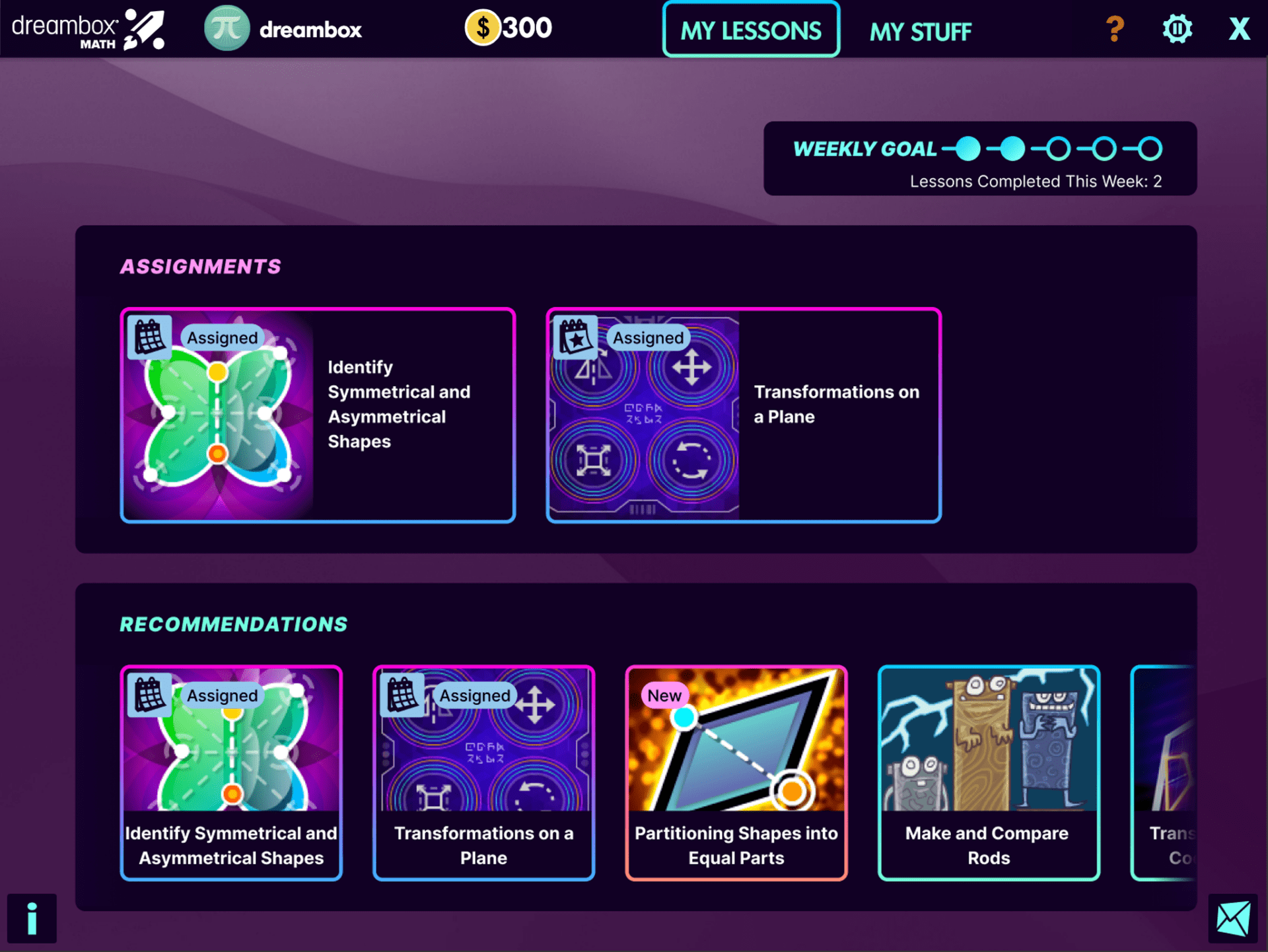
  • Students will now have an easier time navigating lessons. The fresh lesson chooser design offers them greater clarity and ownership in their learning, with an Assignment panel that appears when teachers create assignments, enabling students to distinguish teacher-assigned tasks from lessons recommended by DreamBox.  
  • There’s something powerful about seeing your progress in real-time. With a prominently featured weekly goal tracker, students can’t miss an opportunity to self-monitor their achievements, stay motivated, and remain accountable to their learning goals.  
  • It’s augmenting math with an all-new vibe. Say hello to a fresh experience —this vibrant and engaging engagement is reflective of middle schoolers’ tastes and personal interests.  

“I like this design better than the actual one . . . if you change your design like this and then people take a look at it, they're probably going to start wanting to work on DreamBox more often.”

Why Educators Will Love It

Middle school teachers and administrators will reap the benefits of these updates too. Students who feel more in control of their learning often engage at higher levels, making teaching not just easier, but more impactful.  

Here’s how the new DreamBox middle school experience supports educators: 

  • Fostering Independence: With clear visibility into assignments and goals, students are equipped to take more ownership of their learning. Educators can simply assign lessons, confident that students will take the reins from there.  
  • More engagement: Students and educators both benefit from the learning impact of DreamBox with better data that informs teaching decisions with little to no additional effort. 
  • Meaningful Goal Tracking: Improved engagement means teachers get deeper insights into student learning.   

Gazing into the Future

This is just the beginning. Updates to the middle school experience will continue into 2026 with: 

  • Student-Facing Reporting Tools designed to empower students to set and monitor their own progress—boosting both confidence and accountability.  
  • Exciting New Engagement Elements that continue to delight and motivate students, taking math learning to the next level of fun and interactivity.  
  • Ongoing lesson updates and new lessons for Grades 6–8 over the longer term to better directly align with middle school curriculum as well as educator experience improvements to support teaching routines.  

With these updates, we’re excited to support teachers and administrators with tools that elevate their dedicated work, improve classroom outcomes, and cultivate a love for learning.  

Together, we can make middle school math a place where students not only succeed— but thrive. 

To learn more about how DreamBox can take your math instruction to the next level, visit our back-to-school landing page or reach out to a member of our team 

Get an in-depth look into the exciting updates coming for the 2025-2026 school year!

The post Leveling Up Middle School Math Engagement with DreamBox appeared first on Discovery Education.

]]>
lesson-chooser-screenshot.png
Explore the New DreamBox Math Curriculum Guide https://www.discoveryeducation.com/blog/de-news/explore-the-new-dreambox-math-curriculum-guide/ Mon, 07 Apr 2025 19:30:32 +0000 https://www.discoveryeducation.com/?post_type=blog&p=186419 By giving educators the tools they need to connect instruction, address gaps, and foster enrichment, DreamBox is helping schools and districts create a lasting impact on student outcomes.   We’re excited to announce the release of our all-new interactive Curriculum Guide! Designed with educators in mind, this interactive guide empowers teachers, instructional coaches, and administrators to […]

The post Explore the New DreamBox Math Curriculum Guide appeared first on Discovery Education.

]]>

By giving educators the tools they need to connect instruction, address gaps, and foster enrichment, DreamBox is helping schools and districts create a lasting impact on student outcomes.  

We’re excited to announce the release of our all-new interactive Curriculum Guide! Designed with educators in mind, this interactive guide empowers teachers, instructional coaches, and administrators to connect DreamBox lessons to classroom instruction like never before. Whether you’re looking to solidify classroom connections, gain familiarity with lessons and lesson progressions, or align with state standards, the new curriculum guide has you covered.  

Reinforcing Classroom Connections

At DreamBox, we know that the best math instruction happens when it’s deeply tied to what’s being taught in real classrooms. That’s why our Curriculum Guide is built to make those connections seamless. Teachers can now filter and sort lessons by DreamBox Learning Units or by their state standards, enabling educators to see the full breadth and depth of lesson coverage in DreamBox Math 

Curriculum Guide Home Domains png

Increased Flexibility for Teachers

Teachers want to spend less time navigating tools and more time inspiring students. With unprecedented visibility into lesson groups and individual lessons, you can confidently align DreamBox to your instructional goals. Whether students are just starting on a concept, in progress, or reviewing, you can easily find a lesson to support getting them to the next level. This flexibility makes it easier than ever to pre-teach concepts, provide intervention or enrichment, and support small-group instruction. 

What’s New in the DreamBox Curriculum Guide?

The Curriculum Guide is an essential tool for any educator looking to enhance their teaching with DreamBox Math. Whether you’re complementing your curriculum, supporting a struggling student, or challenging advanced learners, DreamBox has the perfect lesson for every scenario.  

Curriculum Guide Home Domains Gr 3 MD View all png

1. Scope & Sequence of Lessons Made Transparent

Navigate the full breadth and depth of DreamBox’s curriculum with ease. You’ll have clear insight into the progression of lessons and how they evolve to support complex math concepts.  

2. Smart, Intuitive Filters

Quickly find the exact lesson you need by filtering by: 

  • Grade Level 
  • State Standards 
  • DreamBox Learning Unit Domains  

3. Standards Alignment at a Glance

Every lesson tile includes clear alignment to state standards, so you can connect DreamBox lessons directly to your instructional core without skipping a beat.  

4. Lesson Previews

Preview individual lessons for planning, whether you’re preparing for small-group instruction or one-on-one intervention. You’ll gain insights into how lessons engage students and how the adaptive platform personalizes tasks for their needs.  

Take a Deeper Look Inside DreamBox

With DreamBox’s adaptive progression, our lessons meet students where they are and move them toward mastery. Our math curriculum is built to reflect the dynamic process of learning while encouraging students to transfer prior learning. This curriculum guide enables educators to explore our lessons by domain, across three unique lesson types 

Curriculum Guide Home Domains MD Partial Products wArrays FS png

Lesson Types & Progression:

  1. Exploring & Sensemaking: Students explore math concepts and reflect on their understanding, making connections to foundational skills.  
  2. Looking for Structure & Relationships: Lessons identify key mathematical structures and relationships to deepen conceptual understanding.  
  3. Fluency, Application & Procedural Skills: Students practice and apply procedural skills with confidence, progressing toward fluency.  

This intentional progression ensures that every student builds a strong mathematical foundation, regardless of where their learning begins.  

Classroom Applications of DreamBox Lessons:

With the Curriculum Guide, you can: 

  • Enhance instruction with lessons that align directly to your classroom goals.  
  • Pre-teach or reinforce concepts by targeting specific standards or skills.  
  • Support small-group or 1-on-1 instruction, demonstrating lessons based on students’ progress toward proficiency.  

Assignments and feedback tools are also on the way—stay tuned!  

Why This Matters for Educators

DreamBox’s Adaptive Personalization ensures every lesson is tailored to each student’s unique needs. The new DreamBox Curriculum Guide doesn’t just support teaching; it empowers educators to confidently integrate technology into their classrooms. Here’s what it offers at a glance: 

  • Discover thousands of lessons for grades K-8 aligned with your state’s standards and instructional goals.  
  • Gain unprecedented visibility into the scope, sequence, and alignment of DreamBox lessons.  
  • Identify and preview lessons to plan for targeted support to meet your students where they are, and ensure every learner has the opportunity to succeed.  
  • Get a clearer understanding of the lessons recommended in students’ personalized learning paths and identify lessons to assign and support deeper curricular connections. 

Building Connections for Educators  

We’ve added this capability to DreamBox Math based on the feedback we’ve heard from our partners and we’re super excited of what’s coming soon, like the ability to assign personalized lessons from the Curriculum Guide. 

Plus, this new foundation will allow us to continue gathering invaluable feedback from you, our amazing educators. Together, we’ll keep building what every teacher and every student needs to achieve math excellence. 

Experience the Curriculum Guide Today

We’re thrilled to bring you this new tool, and we can’t wait to hear how it transforms the way you teach math. Log into your DreamBox account today to explore the Curriculum Guide—and get ready to experience a whole new level of teaching excellence.  

Don’t have an account yet? Start your free trial and see what’s possible with DreamBox. Together, we can inspire a lifelong love of learning in math.  

Happy teaching,  

The DreamBox Team  

Get an in-depth look into the exciting updates coming for the 2025-2026 school year!

The post Explore the New DreamBox Math Curriculum Guide appeared first on Discovery Education.

]]>
Curriculum-Guide-Home-Domains.png Curriculum-Guide-Home-Domains-Gr-3-MD-View-all.png Curriculum-Guide-Home-Domains-MD-Partial-Products-wArrays-FS.png
Six Strategies to Help English Language Learners in Math https://www.discoveryeducation.com/blog/teaching-and-learning/six-strategies-to-help-english-language-learners-in-math/ Mon, 07 Apr 2025 19:29:20 +0000 https://www.discoveryeducation.com/?post_type=blog&p=183563 The majority of the 5.5 million English Language Learners (ELLs) in the U.S. public school system speak Spanish as their first language, which makes the capability of teaching math in Spanish, using bilingual teachers or teaching assistants, a high priority. Many of these students may have difficulty learning effectively in English and require specialized or […]

The post Six Strategies to Help English Language Learners in Math appeared first on Discovery Education.

]]>

The majority of the 5.5 million English Language Learners (ELLs) in the U.S. public school system speak Spanish as their first language, which makes the capability of teaching math in Spanish, using bilingual teachers or teaching assistants, a high priority. Many of these students may have difficulty learning effectively in English and require specialized or modified instruction, either from their teacher or a Spanish online math program. Here are six strategies to help ELLs succeed in math:

1. Utilize Bilingual Faculty and Support Staff

There is evidence that Spanish-speaking teachers, or ancillary staff who speak Spanish, can help ELLs to build math skills as they build vocabulary in both English and mathematics. “The Inclusive Classroom, Teaching Mathematics and Science to English-Language Learners” supports the idea that when students use their native language in the classroom to work with their peers or individually, their academic performance as well as English-language development improves. Additionally, skills in content areas like mathematics and social studies, once understood in the first language, are retained when instruction shifts to the second language.

2. Set High Expectations and Utilize Rigorous Curriculum

The National Council of Teachers of Mathematics (NCTM) recommends teaching a rigorous, standards-based curriculum and never lowering expectations for ELLs even though additional time and instruction will likely be required. They also suggest that students are best equipped to meet and exceed math expectations when they are provided with abundant and diverse opportunities for speaking, listening, reading, and writing. Also, teachers should encourage their ELL students to take intellectual risks, construct meaning of math concepts, and seek reinterpretations of knowledge within compatible social contexts to make better sense of mathematical ideas.

3. Use Visual Contexts and Manipulatives

Visual math manipulatives provide students with limited English proficiency with ways to construct physical models of abstract mathematical ideas. Multiple modalities are effective in promoting critical thinking and problem-solving skills. Virtual manipulatives have the added advantage of enabling new types of engagement and promoting self-directed learning in a highly interactive, digital environment.

4. Implement Personalized, Individualized, and Blended Models

Combining face-to-face instruction with online learning has yielded strong results as an education strategy. When education technology uses pedagogically sound approaches and curriculum materials, it can increase the individualization of each student’s learning experience. Technology support also allows teachers to expand and more strategically use the limited time they have as facilitators of math learning for ELLs. This powerful approach can be leveraged to create the additional time required to meet ELL needs.

For schools that are trying to meet the needs of all ELLs with limited time and resources, an investment in technology, particularly adaptive technology, can enable a more personalized blended learning model that meets the needs of all students.

5. Use Balanced and Dynamic Assessment

NCTM suggests that a best practice for ELLs in math is empowering them to demonstrate and explain their understanding in multiple ways. Latino ELLs often have an incomplete grasp of academic math language, so traditional tests aren’t able to provide a complete view of each student’s understanding of math concepts. ELLs commonly know more math than they can demonstrate on traditional assessment instruments.

For example, Research has shown that math test items can be linguistically modified to reduce language load without altering the construct being assessed. In a study conducted by the U.S. Department of Education, linguistic modifications produced an improvement on math tests among ELLs, while English-proficient (EP) scores remained the same.

6. Increase Engagement and Motivation

Making curriculum engaging and accessible to all students is key. One way to improve engagement is to drive greater oral participation for ELLs in math classes. Improved verbal communication in mathematics is not only a way to demonstrate conceptual understanding, it also has the additional benefit of promoting language-learning overall.

Using game-like activities, in class as well as online, is another great way to engage ELLs and English Proficient Students alike, and can aid in developing problem-solving skills and persistence. The most effective math games reward students for both achievement and effort. This is particularly true when trying to level the playing field for ELLs struggling with language.

As English Language Learners work to strengthen their academic skills, they are also working to strengthen their English Language skills! Finding strategies to support students as they embark on their personal language and academic journeys can help inspire new confidence and offer encouragement for these students.

Learn More about DreamBox Math as an Effective Solution for Personalized Learning

The post Six Strategies to Help English Language Learners in Math appeared first on Discovery Education.

]]>
ready-to-use-activities-for-kickstarting-student-curiosity-featured-image-1024×576-1.jpg
Partner-Driven Improvements Enhance Personalized Learning for All Students https://www.discoveryeducation.com/blog/de-news/partner-driven-improvements-enhance-personalized-learning-for-all-students/ Mon, 07 Apr 2025 19:20:16 +0000 https://www.discoveryeducation.com/?post_type=blog&p=183424 The DreamBox Math Difference Every student is a math student. That’s why DreamBox is dedicated to personalizing learning to meet every learner’s unique needs. We’ve worked closely with dedicated educators and their students to learn how we can continue building on this work with new product enhancements that remove more barriers to math engagement for […]

The post Partner-Driven Improvements Enhance Personalized Learning for All Students appeared first on Discovery Education.

]]>

The DreamBox Math Difference

Every student is a math student. That’s why DreamBox is dedicated to personalizing learning to meet every learner’s unique needs. We’ve worked closely with dedicated educators and their students to learn how we can continue building on this work with new product enhancements that remove more barriers to math engagement for every student. Students will notice improved opportunities to access and engage in the program, making the math experience more enjoyable for all 

Research demonstrates that when students are meaningfully and regularly engaged in DreamBox, it can drive real learning growth.  

Boosting Independent Engagement through Improved Accessibility

Access to great learning experiences is in our DNA, and we aim to set a whole new standard. To go beyond just compliance with the Web Content Accessibility Guidelines (WCAG) standards, we have worked together with teachers, special education experts, and students with disabilities to deliver product improvements that make the experience more equitable and effective for all students. 

With DreamBox every student is empowered to independently engage in interactive problem-solving— equipped with access to the tools and mathematical vocabulary they need, in the way they need themso they can develop conceptual understanding, apply a variety of strategies, and gain competence and confidence in mathematical reasoning and skills. K-5 lessons now include: 

Compatibility with assistive technology tools such as magnification and screen reader. 

Screen reader with enhanced alternative descriptions supports concept understanding and streamlines problem-solving for students with limited and low vision. 

See how a student with limited vision can work independently in DreamBox.

Easy-to-tap, -move, and -place elements ease interaction and accommodate a variety of devices, physical needs, and learning styles.  

Intuitive keyboard navigation lets students know where they are on the lesson page and within the manipulative. 

a11ytenframe gif

Clear visuals enable students with low vision and color blindness to distinguish selectable foreground elements from the background.  

In addition to these exciting updates, the team is ensuring that all lessons have the ability to replay instructions so that students can easily refer back to the task at hand.  

Easing Lesson Interaction for Racecourse Lessons

We’ve channeled the enthusiasm that last year’s updates to the Clocks lessons generated. This year, we are pleased to announce a major update to our Racecourse lessons.  

In this lesson, students learn to represent equivalent fractions as part of a whole, using proportional reasoning to ensure their car reaches its destination. A number line is represented as a course where students place distance markers and add stops at equivalent distances along the way. 

Guided by student and teacher feedback, we made a series of improvements that make it easier for students to get started and interact with the manipulative as they progress through this lesson.  

Racecourse Phase 3 Updated Context Roadtrip png

A new “Road Trip” context is more relatable for students and makes the tasks clearer.  

Numbered intervals along the course allow for easier skip counting and streamlines the problem-solving process. 

Meters deplete and refill to provide visual feedback on station placement as the car now moves along the course. 

Larger visuals and more space make it easier for touchscreen (and all) users to place markers along the course. 

Clearer instructions and updated scaffolding ensure students have support and meaningful feedback as they progress through the lesson.   

too soon 1 gif

When you put all of this together, it makes a profound difference in the student experience. This is reflected in students’ reactions  

SMALL multiple markers 1 gif

Personalized Learning For Every Student!

We’re not stopping here We are committed to making every moment matter more in DreamBox Math, to ensure each student can work in their own place, progress at their own pace, experience joy, and gain confidence on their individual journeys toward mathematical excellence. 

The post Partner-Driven Improvements Enhance Personalized Learning for All Students appeared first on Discovery Education.

]]>
a11ytenframe.gif Racecourse_Phase-3_Updated-Context_Roadtrip.png too-soon-1.gif SMALL-multiple-markers-1.gif
Honoring Five Historic Latino and Hispanic Mathematicians https://www.discoveryeducation.com/blog/teaching-and-learning/honoring-five-historic-latino-and-hispanic-mathematicians/ Fri, 04 Apr 2025 19:34:06 +0000 https://www.discoveryeducation.com/?post_type=blog&p=183233 National Hispanic Heritage Month (September 15 to October 15) is the perfect time to highlight the accomplishments of Hispanic and Latino communities in your classroom! Here are five Hispanic and Latino mathematicians to celebrate with students this month:  1. Jaime Escalante (1930-2010) David Butow/Corbis via Getty Images Jaime Escalante was a math educator from Bolivia. He […]

The post Honoring Five Historic Latino and Hispanic Mathematicians appeared first on Discovery Education.

]]>

National Hispanic Heritage Month (September 15 to October 15) is the perfect time to highlight the accomplishments of Hispanic and Latino communities in your classroom! Here are five Hispanic and Latino mathematicians to celebrate with students this month: 

1. Jaime Escalante (1930-2010)

Jaime Escalante 1930 2010 jpg
David Butow/Corbis via Getty Images

Jaime Escalante was a math educator from Bolivia. He immigrated to the United States in the 1960s. In 1974, he accepted a job as a math teacher at Garfield High School in East Los Angeles. The student population was predominantly Hispanic and low-income. It was a challenging place to teach, with a history of violence and academic underperformance. 

Escalante wanted to see his students succeed and started an advanced mathematics program. Eventually, his program grew. In 1982, his largest class took and passed the AP Calculus test. Because so many of his students had passed, the testing company suspected cheating and invalidated their scores. Escalante protested, and many students retook and passed the test months later. This incident gained a lot of public attention and was the basis for the 1988 film Stand and Deliver. 

Jaime Escalante continued teaching until 1998. He received many awards for his work in education, including the Presidential Medal of Excellence, and was inducted into the National Teachers Hall of Fame in 1999. 

2. Ruth Gonzalez (Present)

Ruth Gonzalez Present jpg
Ruth Gonzalez via Rice University

Ruth Gonzalez, born in Houston to Mexican parents, was interested in math throughout elementary school and high school. In 1976, she earned her bachelor’s degree in mathematics at the University of Texas at Austin. While doing research at the Applied Research Laboratories at the university from 1976 to 1980, she earned her master’s degree in mathematics. 

In 1980, Gonzalez joined the Exxon Production Research Company as a geophysical mathematician and continued her graduate work at Rice University. In 1986, she received her Ph.D. in applied mathematics from Rice, making her the first U.S.-born Hispanic woman to earn a doctorate in mathematics! She’s had an extensive career developing seismic imaging tools and encourages other minority girls and women to pursue a career in math and science. 

3. Alberto Pedro Calderón (1920-1998)

Alberto Pedro Calderon 1920 1998 jpg
Alberto Pedro Calderón via Wikipedia

Alberto Pedro Calderón, widely considered one of the 20th century’s most important mathematicians, was born in Mendoza, Argentina. He studied at the University of Chicago and the University of Buenos Aires. While in Chicago, he studied under Antoni Zygmund, a Polish mathematician who was an expert analyst. They went on to collaborate for more than 30 years. 

Calderón and Zygmund developed the theory of singular integral operators. The theory was the basis for one of the most influential movements in mathematics: the Chicago School of (hard) Analysis. This school of thought emphasizes applying mathematical analysis to the study of partial differential equations (PDEs). PDEs are used in science and engineering to measure and describe a variety of phenomena such as sound, heat, electrostatics, and quantum mechanics. 

Calderón’s original work, with and without his mentor, greatly influenced mathematical analysis and ranged over a variety of topics including PDEs, interpolation theory, Cauchy integrals on Lipschitz curves, ergodic theory, and inverse problems in electrical prospection. Some practical applications for Calderón’s work include signal processing, geophysics, and tomography. 

4. Ruy Luís Gomes (1905-1984)

Ruy Luis Gomes 1905 1984 jpg
Ruy Luís Gomes via Wikipedia

Portuguese mathematician Ruy Luís Gomes was one of the leading intellectuals of the 20th century. However, he was persecuted by Portugal’s government for his outspoken ideas and independent thinking. Nonetheless, he was committed to teaching and research, making many significant mathematical contributions and serving as a role model for a generation of intelligent, creative mathematicians.

Gomes passionately believed that teachers should be more than the transmitters of theory. Rather, they should act as active research agents, inspiring students to come up with their own new theories and conclusions. He was an innovator in connecting Portuguese mathematicians with mathematicians and other scientists around the globe.

Gomes also believed in a global mathematics community, promoted through seminars, conferences, short courses, study and research centers and scientific societies. At the time, this idea of global cooperation was radical. The Portuguese government didn’t approve. Gomes, his associates and his students created two influential magazines dedicated to mathematics: Portugaliae Mathematica, mainly composed of research articles and Gazeta Matemática. Both magazines are still published today by the Portuguese Mathematical Society. 

5. Júlio César de Mello e Souza (1895-1974)

Julio Cesar de Mello e Souza 1895 1974 png
Júlio César de Mello e Souza via Wikipedia

Júlio César de Mello e Souza was a Brazilian writer, educator and mathematics professor. He was known for his entertaining books explaining mathematics, most of them published under the pen names of Malba Tahan and Breno de Alencar Bianco. Many of his most popular books incorporate mathematical word problems and puzzles into whimsical stories inspired by the Arabian Nights. His most famous work, The Man Who Counted, recounts the adventures of Beremiz Samir, who uses extraordinary mathematical superpowers to battle dangerous enemies and win fame and fortune. 

Many educators credit Júlio César de Mello e Souza with being an innovator, far ahead of his time, for his use of stories and games to engage students in learning math skills. The Malba Tahan Institute was founded in 2004 by the Brazilian government to preserve this talented writer and mathematician’s legacy. The State Legislature of Rio de Janeiro declared his birthday, May 6, a national holiday: Mathematician’s Day. 

Highlighting the contributions of these Hispanic and Latino mathematicians is a great way to honor National Hispanic Heritage Month and encourage students to explore the history of mathematics all year long! 

The post Honoring Five Historic Latino and Hispanic Mathematicians appeared first on Discovery Education.

]]>
Jaime-Escalante-1930-2010.jpg Ruth-Gonzalez-Present.jpg Alberto-Pedro-Calderon-1920-1998.jpg Ruy-Luis-Gomes-1905-1984.jpg Julio-Cesar-de-Mello-e-Souza-1895-1974.png
Four Principles for Effective Math Intervention https://www.discoveryeducation.com/blog/teaching-and-learning/four-principles-for-effective-math-intervention/ Fri, 04 Apr 2025 19:34:06 +0000 https://www.discoveryeducation.com/?post_type=blog&p=183234 The Institute for Education Sciences, an authority on Response to Intervention (RtI) for math published a groundbreaking report on RtI that outlines a series of intervention recommendations. The report Assisting Students Struggling with Mathematics: Response to Intervention (RtI) for Elementary and Middle schools covers recommendations that were judged to have strong or moderate evidence to support […]

The post Four Principles for Effective Math Intervention appeared first on Discovery Education.

]]>

The Institute for Education Sciences, an authority on Response to Intervention (RtI) for math published a groundbreaking report on RtI that outlines a series of intervention recommendations. The report Assisting Students Struggling with Mathematics: Response to Intervention (RtI) for Elementary and Middle schools covers recommendations that were judged to have strong or moderate evidence to support RtI and provide the foundation for effective math intervention. Here are specific strategies that fall under these four key recommendations:

1. Instruction during the intervention should be explicit and systematic.

This recommendation from the report includes providing models of proficient problem solving, verbalization of thought processes, guided practice, corrective feedback, and frequent cumulative review.

Students who have been classified as Tier 2 or 3 in RtI need their instruction to be organized and scaffolded. They lack the numeracy skills and background knowledge to engage in theoretical exercises with math

Nothing is more systematic than the four-step approach to problem solving, first outlined by educator George Polly in 1945:

  1.  Understand the problem. Restate the problem, and then identify the information given and the information that needs to be determined.
  2. Make a plan. Relate the problem to similar problems solved in the past. Consider possible strategies, and then select a strategy or a combination of strategies
  3. Carry out the plan. Execute the chosen strategy and perform the necessary calculations. Revise and apply different strategies as necessary. 
  4. Look back at the solution. Evaluate the strategy/strategies used for problem solving and then assess if there is a better way to approach the problem.
This four-step approach helps students to become confident, independent learners, and is an effective math intervention that builds foundational skills.

2. Interventions should include instruction on solving word problems that is based on common underlying structures.

Math Intervention Tile 1 jpg

A stripped-down version of the Gradual Release Model—the “I do, We do, You do” strategy—is effective in all levels of education. As RtI students require as much structure as possible, the strategy gives them an effective way to know what to expect from a lesson. In word problems, not only can “I do, We do, You do” be used to solve problems, it can also be used to have students create their own word problems, reaching synthesis, a higher level of taxonomy. Students should start with sentences that involve a specific math operation and build from there. (McCarney, S. B., Cummins Wunderlich, K., Bauer, A. The Teacher’s Resource Guide.)

3. Intervention materials should include opportunities for students to work with visual representations of mathematical ideas.

This recommendation from the RtI report goes on to say that interventionists should be proficient in the use of visual representations of mathematical ideas. Graphics are important in math instruction, especially as the curriculum becomes more data=based under the Common Core State Standards. RtI students are not excluded from having to be able to read charts, graphs, and other math graphics. Intervention Central, which provides educators with free RtI resources, has a great intervention that uses the Question-Answer Relationship (QAR) to help students break down math graphics. In short, QARs come in four types:

  1.  “Right There” questions are found explicitly in the graphic.
  2.  “Think and Search” questions are not quite as explicit, but still can be found in the graphic with some close analysis.
  3. “Author and You” questions ask students to compare the data with their own life experiences and opinions.
  4. “On My Own” questions require only the student’s own knowledge and experiences to answer.

4. Interventions at all grade levels should devote about 10 minutes in each session to building fluent retrieval of basic arithmetic facts.

Rehearsal of math facts is a key step in the RtI process because many of the students who fall into Tier 2 or 3 status are missing key pieces of background information, usually in the form of math facts. 

Taking ten minutes each day to review facts is typically done with flash cards, which can be tedious and, therefore, does not always prove to be effective. Another strategy, described by Intervention Central, uses flash-card practice that balances “known” facts with “unknown” facts. Unknown facts are modeled by a teacher or tutor and then presented with known facts—those already mastered by the student—in a sequence. Not only does this systematically build recall, it also builds confidence in the student because they are consistently getting cards correct throughout the process. 

Using Technology to Boost RtI for Math

Digital curriculum, at its best, incorporates the scaffolds and formative assessment that define successful RtI for math. Personalized learning and ongoing, robust data collection provide a meaningful feedback loop for both the student and teacher that leads to deeper learning and higher achievement. Real-time feedback—while learning is happening—is critical so that students don’t practice new math skills, again and again, incorrectly.  

Technological interventions to boost math achievement can be an important part of a successful math intervention, but a commitment to the process is also a necessary part of helping students succeed in math and sharpen their math skills.

The post Four Principles for Effective Math Intervention appeared first on Discovery Education.

]]>
Math-Intervention-Tile-1.jpg
Architecture and Construction Through Mathematics https://www.discoveryeducation.com/blog/teaching-and-learning/architecture-and-construction-through-mathematics/ Fri, 04 Apr 2025 19:33:49 +0000 https://www.discoveryeducation.com/?post_type=blog&p=182869 Every building you spend time in––schools, libraries, houses, apartment complexes, movie theaters, and even your favorite ice cream shop––is the product of mathematical principles applied to design and construction. Have you ever wondered how building professionals incorporate math to create the common structures you walk in and out of every day? What is Architecture? Before […]

The post Architecture and Construction Through Mathematics appeared first on Discovery Education.

]]>

Every building you spend time in––schools, libraries, houses, apartment complexes, movie theaters, and even your favorite ice cream shop––is the product of mathematical principles applied to design and construction. Have you ever wondered how building professionals incorporate math to create the common structures you walk in and out of every day?

What is Architecture?

Before construction workers can build a habitable structure, an architect has to design it. Geometry, algebra, and trigonometry all play a crucial role in architectural design. Architects apply these math forms to plan their blueprints or initial sketch designs. They also calculate the probability of issues the construction team could run into as they bring the design vision to life in three dimensions.

The Golden Ratio

Since ancient times, architects have used geometric principles to plan the shapes and spatial forms of buildings. In 300 B.C., the Greek mathematician Euclid defined a mathematical law of nature called the Golden Ratio. For more than two thousand years, architects have used this formula to design proportions in buildings that look pleasing to the human eye and feel balanced. It is also known as the Golden Constant because it manifests literally everywhere.

The Golden Ratio still serves as a basic geometric principle in architecture. You could even call it a timeless archetype, as it evokes in human beings a universal sense of harmony when they see or stand in a building designed with this principle. And perhaps not surprisingly, we see the Golden Ratio demonstrated throughout “architectures” of the natural world. 

Calculating ratio is essential, as well, when it’s time to construct a building from the architectural blueprints. For example, it’s important to get the proportions right between the height and length of a roof. To do that, building professionals divide the length by the height to get the correct ratio.

The Pythagorean Theorem

The Pythagorean theorem, formulated in the 6th century B.C., has also come into play for centuries to calculate the size and shape of a structure. This theorem enables builders to accurately measure right angles. It states that in a triangle the square of the hypotenuse (the long side opposite the right angle) is equal to the sum of the squares of the other two sides. Read here to find out more about how builders use the Pythagorean theorem to make roofs!

Architecture: Then and Now

The most remarkable ancient architecture of all may be the pyramids of Egypt, constructed between 2700 B.C. and 1700 B.C. Most of them were built and scaled at about a 51-degree angle. The Egyptians clearly and mysteriously possessed knowledge of geometry, as evidenced by the accuracy of pyramid construction. 

In the modern world, builders use math every day to do their work. Construction workers add, subtract, divide, multiply, and work with fractions. They measure the area, volume, length, and width. How much steel do they need for an office building? How much weight in books and furniture will the library floors need to bear? Even building a small single-family home calls for careful calculations of square footage, wall angles, roofs, and room sizes. How many square yards of carpet? How much water do you need to fill up a swimming pool?

Chances are you’re in a building right now. Look around at the walls and windows. Math is everyplace you walk into––work, school, home, or pet store. Imagine that you are an architect. How would you apply math to build a small dwelling?

The post Architecture and Construction Through Mathematics appeared first on Discovery Education.

]]>
pyramids.jpg
7 Steps to Build Math Assessments into Your Classroom https://www.discoveryeducation.com/blog/teaching-and-learning/7-steps-to-build-math-assessments-into-your-classroom/ Fri, 04 Apr 2025 19:33:41 +0000 https://www.discoveryeducation.com/?post_type=blog&p=182722 In the last decade, there has been a growing movement toward using varied, embedded assessments in math instruction. Research has shown that embedding a blend of assessment opportunities for teachers and students provides insights into student progress in the moments of learning, maximizes engagement, and moves students forward. Here are 7 suggestions for successfully integrating math […]

The post 7 Steps to Build Math Assessments into Your Classroom appeared first on Discovery Education.

]]>

In the last decade, there has been a growing movement toward using varied, embedded assessments in math instruction.

Research has shown that embedding a blend of assessment opportunities for teachers and students provides insights into student progress in the moments of learning, maximizes engagement, and moves students forward.

Here are 7 suggestions for successfully integrating math assessments into everyday instruction.

1. Embed Assessment

Teachers are constantly embedding assessment opportunities into instruction every day, even when they may not realize it. They observe students in many different environments—playing games, working with their friends, completing assignments, and learning through digital resources. Teachers can learn how their students learn, how they think, how they participate in groups. These informal math assessments provide nuggets of information that can be powerful in helping teachers make decisions about how to individualize, differentiate, and personalize math instruction.

2. Blend Informal and Formal Math Assessments

Both informal and formal assessments can provide key insights throughout learning. Teachers, as well as students, can observe and evaluate understanding during the learning process informally, such as through discussion, peer reviews and self-reflections, to ensure learning and instruction are on target. More formal assessments towards the end of the learning cycle can provide confirmation of what students have learned or what math concepts and skills require remediation and even enrichment. Together, formal and informal assessments can provide educators a clearer, richer picture of a student’s progress toward their learning goals.

3. Use the Right Tools for the Task

Experts know how to use the right tools for the right problem in a strategic way. Use and mastery of digital, interactive tools in assessment is good practice. Knowing what the tools are, when a tool is needed and how to choose the right tool is critical to preparing our students for college and beyond. Teachers can observe and assess if students are using the tools in the right way—or even an interesting way—to solve a real-world problem, and technology can help capture the data for teachers.

4. Take Play Seriously

Students can learn in all kinds of situations, including play. When play is situated purposefully in learning, students can learn applications more quickly and can transfer the skills more readily. They can more freely make mistakes, try again, and persevere to find solutions. There is value in each.

5. Put Students in the Driver's Seat

Research has shown that when students self-assess, reflect, and engage in progress monitoring, they become more engaged in and responsible for their own learning and do better. Students of all ages should be involved in the goal-setting process and in seeing how they are doing against those goals. The visualization of this information is critical: they must be able to clearly see progress for themselves to become engaged in their own success. They learn from their mistakes and benefit from seeing where they are headed.

6. Let the Data Tell the Story

Just as students can benefit from seeing their progress, teachers need ways to track student progress for each student. With the demands of teaching and with many teachers having multiple classes and large class sizes, teachers need tools to quickly see where they are in their understanding, and to answer questions such as:

  • How is my class doing overall?
  • Where is each of my students on the spectrum of the goals I have for them?
  • Do I see a pattern of misconceptions and mistakes?
  • What students need small group or peer-collaborations?
  • What motivates them and engages them in their own learning?
  • What do they need next?

The most effective instructional decisions are driven from answers to these questions. Research shows that teachers don’t have always have the time, tools, and training to answer these questions completely.

7. Find Support through Professional Learning

Teachers need the skills and tools to employ successful informal and formal assessment techniques in their classroom. In addition, teachers need the skills and the autonomy to create assessment opportunities throughout learning, particularly with informal assessment, to really understand how to get to the bottom of what students know and don’t know in the moments of learning where it is most critical. Teachers also need to be comfortable with a balance of instructional approaches, including inquiry-based models. Just as we teach students, teaching teachers to develop the skills to ask questions effectively, gather data and take action will help them prepare students in a way that they will be ready for deeper learning, as well as various high-stakes assessments.

Administrators play a huge role in creating a culture that values informal math assessment, a shift in paradigm for many schools. Many teachers may fall back on a quiz or drills, when there is rich, instructionally useful information that can be made simply through observation and engaging activities.

More closely integrating assessments into math instruction is just one of the ways educators nationwide are working to improve academic achievement and create lifelong learners. 

The post 7 Steps to Build Math Assessments into Your Classroom appeared first on Discovery Education.

]]>
6 Summer Reading and Math Activities for Elementary Students https://www.discoveryeducation.com/blog/teaching-and-learning/6-summer-reading-and-math-activities-for-elementary-students/ Fri, 04 Apr 2025 19:33:39 +0000 https://www.discoveryeducation.com/?post_type=blog&p=182703 Just because it’s summer doesn’t mean students have to stop learning. Everywhere you look there are opportunities for them to expand their math and reading skills. Discovery Education is here to help teachers support students’ learning this summer. Here are six fun math and reading activities that families can enjoy together while students improve their […]

The post 6 Summer Reading and Math Activities for Elementary Students appeared first on Discovery Education.

]]>

Just because it’s summer doesn’t mean students have to stop learning. Everywhere you look there are opportunities for them to expand their math and reading skills. Discovery Education is here to help teachers support students’ learning this summer. Here are six fun math and reading activities that families can enjoy together while students improve their reading and math abilities.

1. Play Card Games

Develop number sense with card games. Counting, estimating, adding, subtracting, multiplying and working with fractions and money are important skills. The more students use numbers, the better they understand number relationships. The simple game of “War” helps them recognize numbers that are greater than or less than others, or each player can take two cards from the pile and add (or subtract or multiply) their two numbers. The bigger number (or smaller number in subtraction) wins that round. Students practice computation skills, while improving their mental math strategies.

2. Use Storytelling

Have fun with make-believe! Writing stories is great for practicing reading, writing and art skills – all things students would normally do in school. Give them blank pieces of paper or a journal. Have students create their own stories or recreate one of their classic favorites. Maybe have them write down everything they do in one day to turn it into a story the next day – complete with illustrations.

3. Draw and Build

Try out two-dimensional fun: Many students love to draw. Why not incorporate shapes and geometric vocabulary? Ask them to make an ice cream cone using two shapes. Talk about the attributes of the shape. How many sides does the triangle have? How many angles? Which lines are parallel?

Take thinking to the next level with three-dimensional building: Using building sets, let learners explore and create. Ask them to build a structure for a certain purpose or that meets certain criteria (it needs to have a way for people to enter and exit, or it must have a place for the horses to sleep). After they build it, they’ll love describing to you how it functions to meet its given purpose.

4. Dream About Vacation Destinations

Research and plan vacation dreams together. Have students imagine what they’d do on the perfect vacation. Help them research their vacation destination, writing down how long they’d stay, what they’d do and how they’d do it. For instance, a visit to a water park or National Park. Visit the site online and learn as much as possible about the rules, times, activities, cost per day and what to wear. Create a list of necessary items and turn it into a writing and reading adventure, complete with a story line.

5. Solve Real-life Problems

Work through problems together. Involve your learner in real-life problem-solving: think out loud and explain your reasoning. When planting a garden, how many seed packets will we need? Calculate how many seeds we’ll need per row at six inches apart. What tool should we measure with or should we estimate? The more kids hear your reasoning, the more comfortable they will become using math!

6. Get to Know Your Library

read aloud jpg

Cultivate lifelong learning. Most libraries have summer programs to keep students learning while they’re not in school. Visit your library to learn about summer programs for kids. Libraries read aloud for younger children and have book clubs and discussion groups for older children and teens. Each summer reading program is a little different, so check with your local library and see what it has to offer.

You can help students have math and reading fun all summer long with engaging games, activities, and projects!

The post 6 Summer Reading and Math Activities for Elementary Students appeared first on Discovery Education.

]]>
read-aloud.jpg