Curiosity | Discovery Education Nurture Curiosity Wed, 30 Jul 2025 15:23:59 +0000 en-US hourly 1 https://wordpress.org/?v=6.8.3 Unlocking Potential in 2025: A New Era of Discovery Education https://www.discoveryeducation.com/blog/de-news/unlocking-potential-in-2025-a-new-era-of-discovery-education/ Tue, 08 Apr 2025 19:34:33 +0000 https://www.discoveryeducation.com/?post_type=blog&p=186447 For over 20 years, Discovery Education has empowered educators to inspire curiosity, build confidence, and accelerate learning. As education evolves—shaping how students learn, increasing demands on teachers, and adding complexity to classrooms—we have evolved too, continuously innovating to meet these changing needs. This year, we’re introducing updates designed to make teaching more effective, engaging, and […]

The post Unlocking Potential in 2025: A New Era of Discovery Education appeared first on Discovery Education.

]]>

For over 20 years, Discovery Education has empowered educators to inspire curiosity, build confidence, and accelerate learning. As education evolves—shaping how students learn, increasing demands on teachers, and adding complexity to classrooms—we have evolved too, continuously innovating to meet these changing needs. This year, we’re introducing updates designed to make teaching more effective, engaging, and personalized—ensuring educators have the support they need to create lasting, meaningful learning experiences. And while many of these updates support educators, others are designed for students, nurturing their natural curiosity and joy in learning.

With every advancement, improvement, and new offering we bring, one thing will remain constant: our commitment to being the most trusted learning partner, equipping educators and engaging students to succeed in a dynamic world. We’ve listened closely to students, teachers, school leaders, district administrators, and the broader educational community as they have shared their challenges, celebrations, and concerns, and these meaningful conversations have informed our work for the back-to-school season.

Innovative Tools to Enhance Teaching and Learning

Teachers tell us they spend countless hours on assessments, lesson planning, and differentiation. In fact, 94% of educators seek tools that give them time back to focus on students. We’re helping streamline these tasks with new enhancements in Experience, including:

Personalized Content Recommendations High Res scaled jpg

Personalized Content Recommendations

There are thousands of amazing, standards-aligned resources in Experience. Now, finding the perfect resource for any lesson is even easier. Our new Curriculum Aligned Resources feature allows educators to quickly access handpicked content to enhance their core curriculum. Teachers can also get recommendations based on their unique profile and preferences to suggest relevant resources specifically curated for their classroom.

AI TeacherTool | Assess

Our new AI-powered assessment generator allows educators to create standards-aligned assessments in minutes. Teachers can easily customize by reading level, question type, and Bloom’s Taxonomy—all while leveraging Discovery Education’s trusted, cross-curricular resources.

AI TeacherTools Assess High Res png
GoogleAdOn2 png

Improved Integrations

With the new Google Add-on, Discovery Education Experience now integrates seamlessly with Google Classroom, making access to quality content easier and more efficient for educators and students. The new integration offers simplified assignments, more focused access for students, and time-saving workflows for lesson planning.

Enhancing Math Engagement and Support for Educators

Over 90% of teachers believe that personalized instruction can improve learning outcomes, such as test scores, learning retention, and academic performance. As educators work furiously to address declining math scores, we’re making sure they have the right support to differentiate math instruction and drive student outcomes. 

a11ytenframe smaller gif

Improved Accessibility

DreamBox Math lessons now integrate assistive technology, keyboard navigation, and multiple modalities to ensure all students can engage independently. Learn more about these updates HERE.

Enhanced Engagement

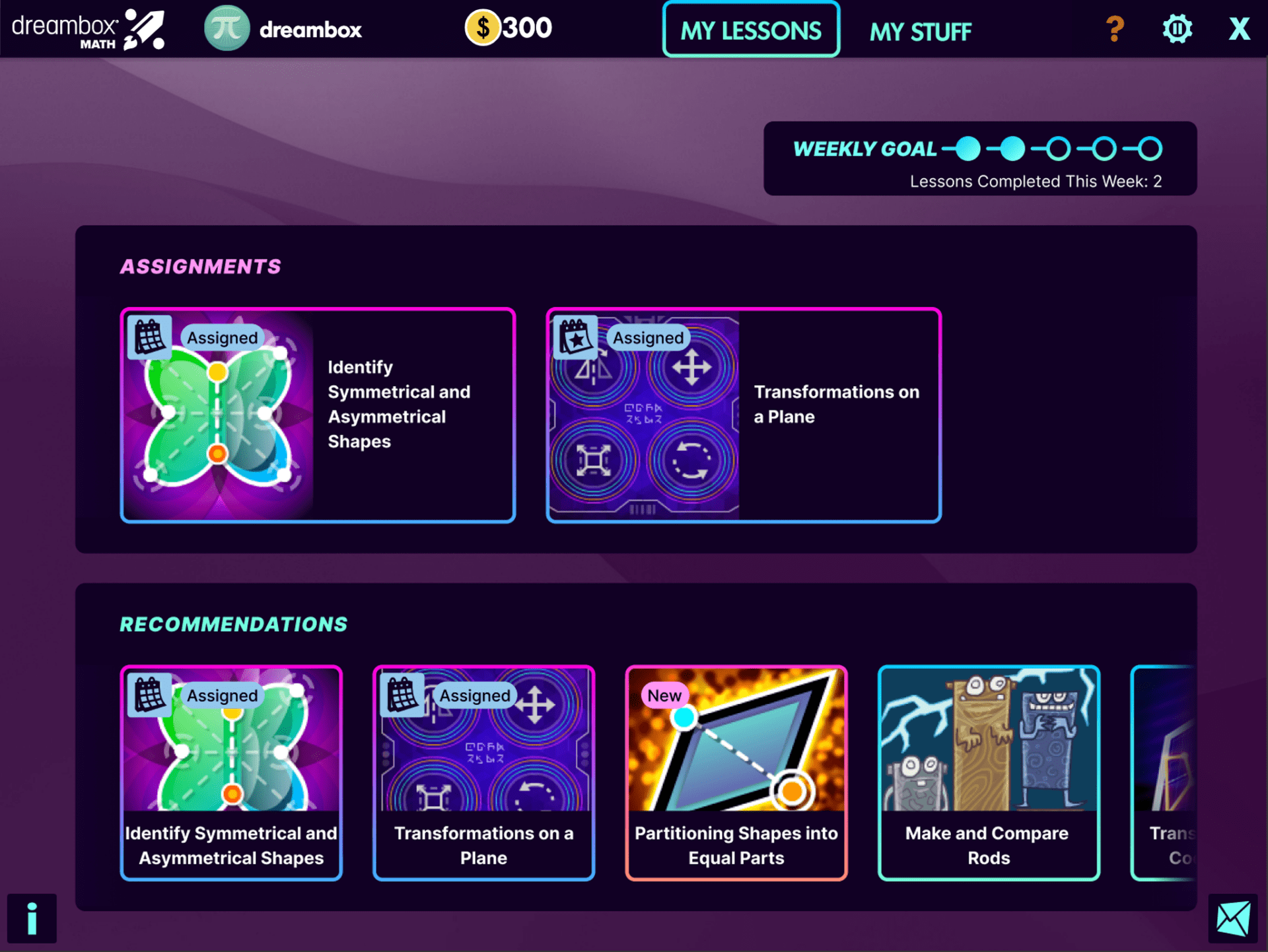
We are rolling out updates to some of the most popular lessons in DreamBox Math to make it easier for students to start, play, and complete lessons successfully. Students will find clearer, always-available instructions, updated scaffolding, enhanced visuals, easier interactivity, and added real-world context for mathematical concepts.

too soon 1 gif
lesson chooser screenshot png

Refreshed Middle School Math Environment

We know that students will feel more engaged and excited about algebra readiness when they can work in an age-appropriate environment. The new middle school environment has a sleek new look and introduces an upgraded lesson chooser, making it easier for students to navigate assignments and personalized lessons. Check out the new middle school experience HERE.

Helpful Curriculum Guide

The new in-product interactive curriculum guide enables educators to explore and align lessons with state standards for targeted instruction. Learn more about the curriculum guide.

Curriculum Guide Home Domains MD Partial Products wArrays png

Building Future-Ready Classrooms

Students crave access to content that excites and inspires them. And, when educators spark connections showing how daily lessons apply inside of class and beyond, they can make learning meaningful. In fact, 80% of students believe that content that connects to real-world experiences is essential for their day-to-day learning.

03 CC Educator Connector Profile 011025 jpg

Career Connect Available to All Experience Partners

Career Connect brings industry professionals right into classrooms, allowing teachers to request virtual visits from employee volunteers. The feature provides experiential knowledge that reinforces educational concepts as it relates to real-world problem solving and innovation.

New Career resources in Experience will help educators show students the real-world relevance of their daily learning while building career awareness, exploration, and preparedness. These resources provide a strong connection to K-8 instruction, ensuring that career readiness begins early and empowers students to imagine endless possibilities beyond the classroom.

New, Exciting Lessons Across Our Programs

  • New Experience Lessons: Experience’s vast library of curated educational content continues to grow to meet the needs of modern K-12 classrooms. For back-to-school, educators will find even more instructional resources with an Enhanced Instructional Strategy Library and Model Lessons. Students and teachers will also have access to new K-2 civics lessons, ELA Fix-It Models for middle school, and new DE Original videos for ELA and social studies.  
  • DreamBox Reading Expands to Grade 5: DreamBox Reading’s adaptive engine, already providing personalized reading instruction for PreK-2 students, will now support literacy development for grades 3-5. New lessons include foundational phonics, fluency, vocabulary, and comprehension strategies, helping older students master essential reading skills.
  • More Mystery Science Fun: Mystery Science will feature new resources, including open-and-go lessons and vocabulary supports on topics like matter and water. Plus, we’re updating Anchor Layers on all units.

Get an in-depth look into the exciting updates coming for the 2025-2026 school year!

The post Unlocking Potential in 2025: A New Era of Discovery Education appeared first on Discovery Education.

]]>
Personalized-Content-Recommendations-High-Res-scaled.jpg AI-TeacherTools-Assess-High-Res.png GoogleAdOn2.png a11ytenframe-smaller.gif too-soon-1.gif lesson-chooser-screenshot.png Curriculum-Guide-Home-Domains-MD-Partial-Products-wArrays.png 03-CC-Educator-Connector-Profile-011025.jpg
Intrinsic Motivation: Why It’s Lacking in Students and How to Foster It https://www.discoveryeducation.com/blog/teaching-and-learning/intrinsic-motivation-why-its-lacking-in-students-and-how-to-foster-it/ Mon, 07 Apr 2025 19:28:11 +0000 https://www.discoveryeducation.com/?post_type=blog&p=183372 The drive to engage and motivate students is a critical factor in their ability to learn and retain knowledge. Developing these for learners creates the conditions where they are giving their attention and want to learn. Motivation comes in two forms: extrinsic and intrinsic. Extrinsic is often related to a drive to finish, to achieve […]

The post Intrinsic Motivation: Why It’s Lacking in Students and How to Foster It appeared first on Discovery Education.

]]>

The drive to engage and motivate students is a critical factor in their ability to learn and retain knowledge. Developing these for learners creates the conditions where they are giving their attention and want to learn.

Motivation comes in two forms: extrinsic and intrinsic. Extrinsic is often related to a drive to finish, to achieve and obtain the rewards. It can also be driven by not so positive forces. Intrinsic on the other hand is all about pursuing learning for the interest, fulfilment, and even joy it can bring. I can still remember the moments in the classroom where my engagement turned to intrinsic motivation that has fueled a lifelong love of some subjects. 

Students who are intrinsically motivated tend to develop higher engagement levels and achieve greater academic success. It can also lead to a deeper involvement with learning across the board. In reality, we have to achieve learning through combinations of engagement and motivation and sometimes through sheer effort of will.

Extrinsic motivation is by far the easiest to generate. The push to achieve grades, avoid failure (real or perceived) and the desire to achieve rewards are relatively simple to execute in the classroom. These are the mechanics of motivation, and they are important to drive learning. Test scores must be achieved, but what about the more subtle intrinsic motivation? How do we trigger personal interest and enthusiasm for the inherent pursuit of learning?

Some of the barriers to developing intrinsic motivation are: 

  • Overuse of extrinsic rewards: a sole reliance on rewards and grades can diminish the intrinsic value of learning.
  • A lack of autonomy: students with little or no agency in how they learn or how they demonstrate their learning quickly become disengaged. 
  • An overcrowded curriculum: it’s hard to give space to developing intrinsic motivation when it counts. 
  • Engineering motivation: it takes planning and time to create the right conditions.

Curiosity

A great starting point is to create a moment that triggers a strong feeling of curiosity. Curiosity feeds motivation. The more curious, the more we need to engage and discover. One great way to do this is by using immersive content. Immersive content comes in all shapes and sizes, from full blown virtual reality, augmented reality, games based learning, to all the immersive content we have always loved such as books, films and music.

Curiosity Through Immersive Learning

Immersive content can provide a powerful, disruptive moment that makes students stop in their tracks, generating an intense level of curiosity and prompting full attention.

Immersive technologies like Sandbox AR provide an exciting opportunity to engage students on a deeper level. The app allows students to explore historical events, scientific scenarios, geographical environments, and their own created worlds in an interactive, virtual space. Once made, students can scale them up and inhabit them. This powerful sparking of curiosity works on so many levels. Students feel they are experiencing their created world in real life, and this fosters a strong connection with the underlying concept or topic. By making learning more tactile and engaging, students are drawn into the material and motivated to learn for the sake of discovery itself.

By integrating such innovative tools into the curriculum, educators can create meaningful connections between learning and the real world, fostering autonomy, curiosity, and a love of learning that lasts long after students leave the classroom.

AR experiences like those offered by Sandbox AR bridge the gap between abstract concepts and real-world understanding. These tools transform passive learning into active exploration, sparking curiosity and personal interest, the essential drivers of intrinsic motivation.

By integrating such innovative tools into the curriculum, educators can create meaningful connections between learning and the real world, fostering autonomy, curiosity, and a love of learning that lasts long after students leave the classroom.

The post Intrinsic Motivation: Why It’s Lacking in Students and How to Foster It appeared first on Discovery Education.

]]>
gamification-tile.jpg immersion-scuba.png Picture of Phil Birchinall
Three Challenges When Nurturing Curiosity https://www.discoveryeducation.com/blog/educational-leadership/three-challenges-when-nurturing-curiosity/ Sat, 05 Apr 2025 19:38:28 +0000 https://www.discoveryeducation.com/?post_type=blog&p=183724 K-12 educators generally value students’ curiosity at every age and grade level, so it may seem surprising that curiosity has been widely overlooked as a learning outcome. However, we can always make a concerted effort to focus on what we believe is important to students and essential for being a healthy young person growing into […]

The post Three Challenges When Nurturing Curiosity appeared first on Discovery Education.

]]>
K-12 educators generally value students’ curiosity at every age and grade level, so it may seem surprising that curiosity has been widely overlooked as a learning outcome. However, we can always make a concerted effort to focus on what we believe is important to students and essential for being a healthy young person growing into adulthood. It starts with making sure we agree on the outcomes we want. 

Because state standards haven’t defined outcomes explicitly related to curiosity, it’s incumbent on us to create tools, like the rubrics I shared in my previous blog, to align on what curiosity looks like so that we can begin to observe and develop it in students. These rubrics are helpful for student self-assessment and surfacing what challenges we should expect as we work to nurture curiosity more intentionally. This post will focus on three inherent challenges to cultivating curiosity.

de icon lightbulb filled png

Challenge #1: Interest​

Interest is the first challenge. As is likely obvious to all educators, curiosity is highly dependent on context. It’s rare to find students who are genuinely curious about everything. Some students are fascinated by art, others are inspired by math and eager to uncover its secrets and logical intricacies. And, many students aren’t. That’s why we can’t hold students to a standard of intrinsic curiosity in every context. 

Expert
Proficient
Developing
Novice

Interest

de icon lightbulb filled png

I’m always excited to listen, learn, and engage regardless of the topic. I’m genuinely curious about most things.

Though I'm more enthusiastic about learning in areas that interest me, I can work to listen, learn, engage, and ask questions about any subject in school.

It's difficult for me to engage and ask questions if I don't care about the topic. My body language often reveals my engagement.

If I don't like what I'm learning or don't care about it, I usually don't engage and don't appear interested in the conversation.

Instead, we aim for Proficiency as described in the Interest rubric. We want each student to be a curious learner and thinker in different contexts, even if it’s for a topic that’s not a current or lifelong passion. Indeed, many adults find their careers by showing a small amount of initial curiosity in an area with a willingness to try something new. Curiosity can be the first domino that sets off a chain reaction for a learner to find their motivation and goals. However, the opposite can also be true—I was considering becoming an optometrist because I’m fascinated by how vision and eyes work. But when I took a human anatomy class and we dissected eyeballs, I quickly realized that a career in medicine wasn’t for me. I’m still fascinated by light and vision, but we don’t need to make a career out of everything that piques our curiosity.

de icon brain filled png

Challenge #2: Deprivation Curiosity​

The second challenge to nurturing curiosity is far less known and has only recently surfaced through research: curiosity has a dark side. As you’ve been reading and thinking about curiosity, you’ve likely had in mind what researchers consider healthy curiosity, which is called Interest Curiosity. The driving force behind Interest Curiosity is knowledge rooted in intellectual humility. We have to admit to ourselves what we don’t know before we can seek deeper knowledge. People with Interest Curiosity approach learning with the joy of exploration, much like infants and toddlers. And students whose curiosity is motivated in this way are skilled at distinguishing between real and made-up concepts. 

The dark side of curiosity is called Deprivation Curiosity, and the primary motivating factor is to reduce uncertainty. People exhibiting Deprivation Curiosity have an indiscriminate openness to information. Though they are inquisitive, they lack discernment, which makes them susceptible to disinformation. The Skepticism Rubric I developed over fifteen years ago is relevant to these new findings because discernment and critical thinking are essential to being a curious learner. 

Expert
Proficient
Developing
Novice

Skepticism

de icon brain filled png
When presented with information, problems, or questions, I question the underlying assumptions and perspective of the presenter to find deeper meaning.

When I am presented with a problem or new information, I ask questions to determine its meaning and begin reasoning to assess validity and credibility.

I often trust what I hear or read, but if something sounds really weird, I ask questions to learn more.

I immediately accept what is presented. I want an easy answer or method, so I can mindlessly use it forever.

If something “sounds really weird” to a student with Deprivation Curiosity, they typically will not seek out reliable and vetted sources of information to determine if what they’ve heard is true. They’ll often even ignore reliable information entirely because they’ve decided they’re already certain of what they know. And any new, contradictory information will create the uncertainty they’re trying to avoid.

Deprivation Curiosity has been exploited in recent years through social media campaigns that have intentionally spread disinformation and misinformation. Now that deepfakes and AI-generated text, pictures, and videos have come into existence, we have a far more dangerous reality we need to help all students navigate, especially those with Deprivation Curiosity.

de icon question thought filled png

Challenge #3: Fixed Mindset​

A third challenge to cultivating students’ curiosity is connected to a students’ mindset about their capabilities and persistence. It’s one thing to see an unexpected phenomenon, such as a magnifying glass starting a fire, and wonder how it works. It’s another thing entirely to devote time to figuring out how it works and persisting when learning is difficult. Much has been written and said over the past decade about the differences between a growth mindset and a fixed mindset, and I won’t spend time here sharing it. Instead, it’s best to simply describe the mindset behaviors we’re looking for as they relate to curiosity. 

Expert
Proficient
Developing
Novice
Mindset de icon question thought filled png
I’m always excited to listen, learn, and engage regardless of the topic. I’m genuinely curious about most things. 
Though I’m more enthusiastic about learning in areas that interest me, I can work to listen, learn, engage, and ask questions about any subject in school. 
It's difficult for me to engage and ask questions if I don’t care about the topic. My body language often reveals my engagement. 
If I don’t like what I’m learning or don’t care about it, I usually don’t engage and don’t appear interested in the conversation. 

Students with a fixed mindset often avoid challenges and new experiences because they fear that failure will reflect poorly on their abilities, and they don’t believe their abilities can improve. This mindset can prevent students from expressing and pursuing their curiosity. By sharing this rubric with them, we can have a different conversation about how they can learn and grow as a curious learner who exhibits persistence and isn’t worried about making mistakes in the process.

Educators, parents, and students can work together to overcome the curiosity challenges described in this blog.

de icon lightbulb filled png

Interest

By understanding that students may not be interested equally in all subjects, and inspiring them to listen, learn, engage, and ask questions about any subject, we empower them to explore new things without penalizing them for expressing a deeper interest in specific areas.

de icon brain filled png

Deprivation Curiosity

Embolden students to poke holes, ask questions, and dig deeper into areas. By allowing students with Deprivation Curiosity to push back and express skepticism, they will better understand concepts and grow into responsible, reflective consumers of media.

de icon question thought filled png

Fixed Mindset

Motivate students to adopt a growth mindset by praising their effort, resilience, and strategies over innate abilities, emphasizing that challenges and failures are opportunities for learning and growth.

I encourage you to download the curiosity rubric here. You can share this resource with your team to help foster curiosity, measure curiosity, and inform ways in which stakeholders at every level can address curiosity challenges.

Stay tuned for more on how to take these rubrics and use them as blueprints for assessments so that we can accurately capture and report on students’ curiosity. Following the “backwards design” approach, I’ll then provide strategies for cultivating curiosity in our classrooms with practical lesson designs.

Learn More about Nurturing Curiosity fo Your Students

The post Three Challenges When Nurturing Curiosity appeared first on Discovery Education.

]]>

de-icon-lightbulb-filled.png de icon lightbulb filled png de-icon-brain-filled.png de icon brain filled png de-icon-question-thought-filled.png de icon question thought filled png de-icon-lightbulb-filled.png de-icon-brain-filled.png de-icon-question-thought-filled.png
The Importance of Curiosity in Education https://www.discoveryeducation.com/blog/educational-leadership/the-most-important-student-trait-your-district-is-overlooking/ Sat, 05 Apr 2025 19:37:27 +0000 https://www.discoveryeducation.com/?post_type=blog&p=183684 I’ll give you a hint – it starts with the letter C. And it’s not collaboration, communication, critical thinking, creativity, competence, cooperation, citizenship, confidence, capability, or college and career readiness. Those are probably top of mind in most districts. The essential student trait you’re overlooking is hopefully what you’re experiencing right now: curiosity. We’re all […]

The post The Importance of Curiosity in Education appeared first on Discovery Education.

]]>
I’ll give you a hint – it starts with the letter C. And it’s not collaboration, communication, critical thinking, creativity, competence, cooperation, citizenship, confidence, capability, or college and career readiness. Those are probably top of mind in most districts. The essential student trait you’re overlooking is hopefully what you’re experiencing right now: curiosity.
what does curiosity look like png

We’re all born with this natural attribute, and it’s one of the most delightful traits students bring with them to school. Curiosity helps our brains focus, motivates investigation, and inspires new discoveries. And you’d be hard-pressed to find any parent, guardian, or educator who would argue that students should not be curious in both school and life. Yet curiosity remains functionally overlooked as an outcome that’s intentionally cultivated in PreK-12 education; it can’t be found when we examine standards, curricular documents, assessments, and report cards. And curiosity is rarely found explicitly in print materials and online resources.

I first became interested in curiosity over 15 years ago when I was the K-12 Mathematics Coordinator and Strategic Planning Facilitator in my district as we were creating a new mission, vision, and strategic plan. One key part of our new mission was that “all students are capable, curious, and confident learners.” We had added “curious” as an adjective in the second draft, and we kept it through five more revisions as we engaged in community review and gathered input.

During those community conversations, one frequently asked question was, “Can you ever really know if someone’s curious?” To which I would always reply, “It sounds to me like you’re curious.” The English word “curious” was created we needed a way to describe unique, observable characteristics that we didn’t yet have a word for.

Curiosity is an Important Characteristic that Educators Want

29%

"Curiosity and Motivation"

Strong evidence that students were engaged with a program

In a 2022 EdWeek Research Center study, 29% of teachers and administrators said that “curiosity and motivation” were strong evidence that students were engaged with a program. This was the second highest-rated feature after “learning gains” (35%). 

Having spent the last 13 years leading the development of the most effective student self-directed online adaptive math program, creating the conditions that nurture and evoke students’ innate curiosity has been at the forefront of the work I’ve done. Even though we know we want students to be curious, we need to define the specifics of what it looks like in practice so that we can cultivate it and nurture it in students.

What Does Curiosity Look Like?

If we want to nurture curiosity and help students, educators, and parents understand what it looks like, we need to develop and align on some explicit indicators and standards for curiosity. Often, people think of “asking questions” or saying “I wonder if” are a primary indicator that someone is curious, but curiosity goes much broader and deeper than that. 

In addition to those behaviors, generating hypotheses, making observations, and a student’s willingness to engage as a learner with topics they’re not passionate about can also indicate they are curious as they engage in lessons and learning.

My preferred method for developing and communicating goals and learning outcomes is to use rubrics because they show a continuum and range that’s helpful for student self-reflection and growth. Below are three examples of how curiosity exhibits itself along the dimensions of questioning, skepticism, and interest. The verbiage in these examples is targeted toward the middle and high school levels, but the vocabulary in these rubrics could easily be adjusted for the elementary levels.

In addition to those behaviors, generating hypotheses, making observations, and a student’s willingness to engage as a learner with topics they’re not passionate about can also indicate they are curious as they engage in lessons and learning.

Rubrics for Observing and Assessing Three Curiosity Traits

Expert
Proficient
Developing
Novice

Questioning

de icon question thought filled png

I continually ask insightful questions both inside and outside of class that extend the conversation and learning into new areas.

I ask questions before, during, and after class that are relevant to the current conversation and lesson. I'm not complacent with just simple answers.
I ask unrelated questions or just ask for facts. I ask questions only when prompted, and only think about problems someone else tells me about.
Regardless of the topic, I ask few, if any, questions either before or after being presented with problems, questions, or information.

Skepticism

de icon brain filled png
When presented with information, problems, or questions, I question the underlying assumptions and perspective of the presenter to find deeper meaning.
When I am presented with a problem or new information, I ask questions to determine its meaning and begin reasoning to assess validity and credibility.Â
I often trust what I hear or read, but if something sounds really weird, I ask questions to learn more.
I immediately accept what is presented. I want an easy answer or method, so I can mindlessly use it forever.

Interest

de icon lightbulb filled png
I’m always excited to listen, learn, and engage regardless of the topic. I’m genuinely curious about most things.
Though I'm more enthusiastic about learning in areas that interest me, I can work to listen, learn, engage, and ask questions about any subject in school.
It's difficult for me to engage and ask questions if I don't care about the topic. My body language often reveals my engagement.
If I don't like what I'm learning or don't care about it, I usually don't engage and don't appear interested in the conversation.

What's Next in this Blog Series

Be sure to watch for future blog posts in this series, where I’ll share practical ideas for how to assess and report on students’ curiosity along with strategies for cultivating curiosity in our classrooms with intentional lesson design.

Read What's Next in the Curiosity Series

The post The Importance of Curiosity in Education appeared first on Discovery Education.

]]>
what-does-curiosity-look-like.png de icon question thought filled png de icon brain filled png de icon lightbulb filled png Picture of Dr. Tim Hudson
Unleashing the Power of Curiosity to Drive Student Success https://www.discoveryeducation.com/blog/educational-leadership/unleashing-the-power-of-curiosity-to-drive-student-success/ Fri, 04 Apr 2025 19:34:28 +0000 https://www.discoveryeducation.com/?post_type=blog&p=183725 In a recent webinar from District Administration titled “The Power of Curiosity for Student Engagement, Motivation, and Persistence,” Dr. Tim Hudson, Chief Learning Officer at Discovery Education, and Dr. Cheryl Proctor, Deputy Superintendent of Instruction and School Communities for Portland Public Schools got together to share a treasure trove of practical strategies for fostering curiosity […]

The post Unleashing the Power of Curiosity to Drive Student Success appeared first on Discovery Education.

]]>

In a recent webinar from District Administration titled “The Power of Curiosity for Student Engagement, Motivation, and Persistence,” Dr. Tim Hudson, Chief Learning Officer at Discovery Education, and Dr. Cheryl Proctor, Deputy Superintendent of Instruction and School Communities for Portland Public Schools got together to share a treasure trove of practical strategies for fostering curiosity and boosting student engagement. The insights from Dr. Hudson and Dr. Proctor offer a clear roadmap for creating an energetic and supportive educational environment that meets the diverse needs of all students.

Check out these key takeaways for fostering student engagement and the impactful role of AI and technology in modern classrooms.

1. Ask Little Questions with Big Answers

what does curiosity look like png

Dr. Hudson opened the discussion by highlighting how crucial curiosity is in the learning journey. “Curiosity is the engine of achievement,” he remarked. He outlined how cultivating a curious mindset can significantly increase student motivation and persistence. But how do we do this in practical terms? One suggestion from Dr. Hudson is incorporating open-ended questions in lessons that encourage students to think beyond the facts. For example, instead of asking “What is the capital of France?” we might ask “How might Parisian culture influence its role as a capital city?” This makes learning more engaging and promotes critical thinking skills.

2. Strive to Understand Students' Backgrounds

Dr. Proctor shared her own educational journey and underscored the importance of knowing our students’ backgrounds. “Knowing our students’ stories is essential to engaging them in meaningful ways,” she stated. She illustrated this point by talking about the different cultural and socio-economic backgrounds students come from and how these factors influence their learning styles and needs. By understanding these nuances, teachers can adapt their instructional strategies—like using bilingual resources or culturally relevant examples—to better meet each student’s needs.

Knowing our students' stories is essential to engaging them in meaningful ways.

3. Try New Strategies that Use New Technologies

TimePod Adventures Augmented Reality App png

The conversation covered several innovative strategies for boosting student engagement. Dr. Proctor and Dr. Hudson chatted about integrating AI and technology into classrooms, showing how these tools can personalize learning and make educational content more exciting and accessible. For example, using adaptive learning platforms can help keep students engaged by providing them with just the right level of challenge. And the use of virtual reality (VR) can bring subjects like history and science to life, making learning a truly immersive experience. Imagine students exploring ancient civilizations or the human body in 3D!

4. Model Curiosity for Students

A standout theme throughout the webinar was the idea that educators need to be lifelong learners too. Dr. Proctor emphasized staying curious and continually learning about new teaching strategies and technologies. This is key to creating a supportive and engaging learning environment. She shared that attending professional development workshops, participating in peer collaboration sessions, and staying updated with the latest educational research are all ways teachers can keep their curiosity alive. If teachers follow these actions, then they become models for students to also become lifelong learners.

The post Unleashing the Power of Curiosity to Drive Student Success appeared first on Discovery Education.

]]>
what-does-curiosity-look-like.png TimePod-Adventures-Augmented-Reality-App.png
Shaping the Future of Education https://www.discoveryeducation.com/blog/educational-leadership/shaping-the-future-of-education/ Fri, 04 Apr 2025 19:34:19 +0000 https://www.discoveryeducation.com/?post_type=blog&p=183516 What’s driving conversation today in education? From the local school board meetings to the parent-teacher conferences, we know educators get a lot of feedback. Regardless of what is trending, listening to learning communities is a core focus at Discovery Education, as we know it is for education leaders. Our new report based on surveys from […]

The post Shaping the Future of Education appeared first on Discovery Education.

]]>

What’s driving conversation today in education? From the local school board meetings to the parent-teacher conferences, we know educators get a lot of feedback. Regardless of what is trending, listening to learning communities is a core focus at Discovery Education, as we know it is for education leaders. Our new report based on surveys from over 1,500 superintendents, teachers, parents, and students underscores our core focus, and we can’t wait to share the results with you.

The Education Insights Report by Discovery Education, created in partnership with The Harris Poll, pinpoints three game-changing opportunities to shaping the future of education:

  • Prioritize student motivation and engagement by focusing on what makes them curious
  • Integrate life and workforce readiness into the everyday classroom
  • Embrace innovative supports to meet the needs of today’s teachers and students

It also serves as a roadmap for transforming education as we know it. Here are my key takeaways from this revealing report, and why, at Discovery Education, we are more confident than ever about the future of education

Curious Minds, Engaged Students

Curiosity is the engine of learning. By focusing on keeping students curious, we keep them engaged in active learning. Even though most educators agree on the importance of curiosity, many feel that it’s difficult to prioritize alongside other pressures. At Discovery Education, we believe that by nurturing students’ interests through tools including student-led learning, exciting multimedia content, and hands-on activities, teachers can simultaneously instruct and inspire students to think critically, make meaningful connections, and achieve ambitious learning goals.

Prepping for Life, Not Just Exams

The classroom experience needs to go beyond textbooks to prepare students for what comes after school—to show the connection between what we’re teaching and why it matters. Yet less than two-thirds of students feel their schools are preparing them for future workforces. While we’ve long delivered solutions for building students’ interpersonal skills, we recently launched Career Connect, a new tool to bring professional voices into the classroom and ensure students are ready for whatever path they choose to take after graduation.

A Call for Individualized Learning Support

66%

of teachers see a wider variation of knowledge and skills among students compared to five years ago.

Our research found that two-thirds of teachers (66%) observe a wider variation of knowledge and skills among their students compared to five years ago. They’re hungry for support that will help them tailor instruction and build their own confidence as educators. We believe teachers need tools that can help them reach each student individually, without putting more work on their plates. We hear every day from our partners that our DreamBox solutions for math and reading increase learning, motivation, and confidence through AI-powered adaptive learning paths unique to each student.

Keep the Conversation Going

As a former superintendent and principal, I believe that all progress begins with knowledge and understanding. We hope the sentiments uncovered by our Education Insights report will lead to productive dialogue and collaboration across K-12 communities at every level. I’m energized by the passion, dedication, and motivation expressed by every group we surveyed. It’s that commitment to learning growth and achievement that leaves me deeply confident about the opportunity for today’s education leaders to solve the challenges ahead. The Discovery Education team will be there every step of the way.  

Let’s keep the conversation going. Watch Our Virtual Town Hall On-Demand to dive into this report with other education leaders. We’ll meet for an interactive session to share reflections, ideas, and leave feeling inspired.

The post Shaping the Future of Education appeared first on Discovery Education.

]]>
Picture of Dr. Todd Wirt
Key Takeaways from the CGCS Fall Conference https://www.discoveryeducation.com/blog/educational-leadership/key-takeaways-from-the-cgcs-fall-conference/ Fri, 04 Apr 2025 19:34:13 +0000 https://www.discoveryeducation.com/?post_type=blog&p=183375 The Discovery Education team recently attended the Council of the Great City Schools’ 68th Annual Fall Conference in Dallas, Texas. Hosted by Dallas ISD, the event joined educators from large urban schools under the inspiring theme “Leading Innovation & Transformation, We Do Urban Education.” The conference featured a series of compelling sessions where education professionals […]

The post Key Takeaways from the CGCS Fall Conference appeared first on Discovery Education.

]]>

The Discovery Education team recently attended the Council of the Great City Schools’ 68th Annual Fall Conference in Dallas, Texas. Hosted by Dallas ISD, the event joined educators from large urban schools under the inspiring theme "Leading Innovation & Transformation, We Do Urban Education." The conference featured a series of compelling sessions where education professionals shared concrete ideas and strategies to solve their biggest challenges together. We listened carefully to what district leaders had to say, and were excited at how closely their priorities align to key findings in our new Education Insights Report. Read on to learn more.

High-Quality Instructional Materials: Content Matters Because "Skills are Boring"

A popular session was “Big Things Happen Here: Using High-Quality Instructional Materials (HQIM) to Drive Achievement in Urban Schools.” Among the highlights were Charissa Govan and NaTonya Huff from Dallas ISD reaffirming that “content matters because skills are boring.” This simple, yet profound statement captures the heart of effective teaching—specifically that engaging, meaningful content is the right vessel to deliver skills mastery and standards mastery.  

Embedding foundational skills into engaging content makes them more accessible, relevant, and exciting to learn. But don’t forget to lead with the standard(s) being taught so that the critical connection can be made as students are engaged with their learning.

de icon lightbulb filled png

Making the Connection

A key finding from The Education Insights Report shows ~90% of students are motivated to learn new things, while nearly half of teachers (46%) report student engagement has declined compared to 2019. This means the desire to learn is there, yet it’s not being realized. Researchers believe that by focusing on what makes their students curious, teachers will see greater student motivation and engagement. The report offers several ways to accomplish this.

Open All Lines of Communication to Align Goals

The Discovery team also attended the session, “How the Harvard Accelerating Board Capacity Summer Institute is Strengthening Urban School Board Members.” Presented by individuals from districts like Cleveland and Boston along with Harvard, this insightful conversation focused on how school board decisions do not always align to a district’s goals. This can lead to purchasing programs that don’t move the needle for student achievement. If school boards take an academically centered ROI approach to programs, with invaluable input of their educators, they can move the needle in the right direction.

de icon lightbulb filled png

Making the Connection

Another key insight from the report found that only 25% of teachers say the district provides support to make teaching engaging. Yet, 86% of superintendents say they do provide those necessary supports. This disconnect aligns with that between the district and the school board. Collaboration is key to solving these challenges, as leaders and educators agree, so let’s open the lines of communication with all stakeholders.

Focus on Targeted Professional Development

Equally enlightening was the “Jolly Ranchers: Developing Urban School Leaders Through Principal Pipelines” session. Presented by Jefferson County Public Schools and Philadelphia Schools, the discussion focused on leadership pathways and the critical importance of supporting stable and qualified teachers and principals.

de icon lightbulb filled png

Making the Connection

According to the report, teachers’ top four PD interests focus on student engagement, meeting individual student needs, new trends in education, and stress reduction. These also align with teachers’ top reported challenges. By focusing on these areas, school and district leads can ensure they are supporting a stable, qualified, and happy workforce.

Overall, the conference provided the Discovery Education team with rich insights to bolster urban education initiatives. Participation in thought-provoking sessions and exchanges with fellow educators reinforced our commitment to fostering transformative educational experiences. We left Dallas energized and equipped to continue driving excellence in urban education.

Take a deeper dive into the research on how today’s educators and students are navigating current learning environments.

The post Key Takeaways from the CGCS Fall Conference appeared first on Discovery Education.

]]>
de-icon-lightbulb-filled.png de-icon-lightbulb-filled.png de-icon-lightbulb-filled.png
How We Can Celebrate Curiosity https://www.discoveryeducation.com/blog/teaching-and-learning/how-we-can-celebrate-curiosity/ Fri, 04 Apr 2025 19:34:08 +0000 https://www.discoveryeducation.com/?post_type=blog&p=183302 Curiosity is at the heart of everything we do at Discovery Education. We believe that the most powerful learning experiences are those that spark curiosity and drive deeper engagement with the world around us. In fact, curiosity is simply and beautifully a strong desire to learn, so we’d like to highlight the many ways that Discovery […]

The post How We Can Celebrate Curiosity appeared first on Discovery Education.

]]>

Curiosity is at the heart of everything we do at Discovery Education.

We believe that the most powerful learning experiences are those that spark curiosity and drive deeper engagement with the world around us. In fact, curiosity is simply and beautifully a strong desire to learn, so we’d like to highlight the many ways that Discovery Education supports this very natural drive.

Curiosity is a strong force. It doesn’t always follow along chapter or unit lines and it’s not always predictable. A platform with enough resources to satisfy unwavering curiosity requires a seemingly limitless amount of content and frequent additions. The treasury of more than 200,000 videos, Virtual Field Trips, text-based passages, interactives, audio, podcasts, and images in our platform right now aims to include a resource for every source of wonder. And, it’s always expanding.

Can you remember a time when a teacher described a topic or posed a question that created an itch to conduct your own investigations? This is what we’re all striving for: students who are interested and excited by the world of knowledge, who can use the tools and resources at their fingertips to satisfy their own curiosity, and who are deeply engaged with learning.

So, what’s the best way to celebrate curiosity? We think it’s to encourage it. Direct students to specific areas of DE if they have something they’re already curious about or support general curiosity by letting your students roam freely in the safety of our content universe. The content is high-quality, timely, and vetted.

The opportunities abound, but here are just a few samples of the kinds of things students might find based on their particular interests.

I’m curious about the world from authentic perspectives . . .

The Global Oneness Project’s collection of documentary films portrays individuals and communities contending with major issues facing all of humanity. The films provide compelling windows into the changing world. From the last speakers of disappearing languages to a Syrian refugee living in Vancouver, the stories are personal and fascinating.

I’m curious about Native American poetry and power . . .

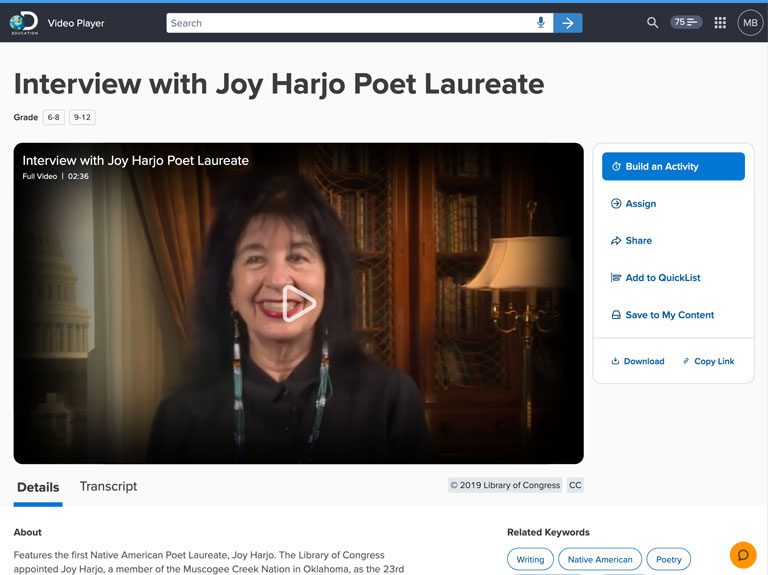
Use Channels to find videos and other resources related to specific topics. The Celebrating Native American Heritage Channel features an interview from the Library of Congress with the first Native American Poet Laureate, Joy Harjo. She speaks of the power and legacy of poetry. And, the More Videos Like This feature leads curious students to related stories. From the interview with Joy Harjo, students can link to a story about Amanda Gorman, the first ever National Youth Poet Laureate and youngest poet to speak at an inauguration.

I’m curious about robotics, manufacturing, machines, AI, and video games . . .

STEM is a huge umbrella for so many topics that pique student curiosity. Learn all about STEM careers—the people, the work, the innovation—with content created by DE’s STEM Careers Coalition. For topics from the wildly innovative trips to Mars to the making of the Madden NFL video game, STEM Careers provides videos, student challenges, classroom activities, Virtual Field Trips, and more.

Think of Discovery Education as a rabbit hole . . . with a map. You and your students will find countless topics, activities, and tools to explore almost any curiosity. For the uncharted experience, there are tools like search, link, and top picks. For the more guided experience, use tools like lesson activities, channels, and educator guides.

Whatever your students wonder and whatever they find, be sure to celebrate the curiosity that inspired them! This month, and every month, celebrate that strong desire for learning by creating a culture of curiosity and growth.

About the Author

Jeanette Edelstein is an educator dedicated to making learning more engaging for students of all ages. She has been a classroom teacher, curriculum designer, and program developer. She was a founding teacher and the gifted and talented coordinator at Mapleton Expeditionary School of the Arts. Her curriculum projects include Hive Alive!, a collection of teaching resources about honey bees, Animal Planet Rescue, a disaster relief and educational vehicle that rescued over 1,000 animals, and CapsinSchool, an elementary curriculum based on the math and science of hockey.

The post How We Can Celebrate Curiosity appeared first on Discovery Education.

]]>
global-oneness-project-768×575-1.jpg joy-harjo-poet-768×575-1.jpg stem-careers-channel-768×575-1.jpg